


“Altitude gave us flavor, Strategy will give us the market“
Coffee has become one of the most beloved beverages across the globe, a drink that not only connects people socially but also drives agricultural economies, exports and local businesses. Nepal coffee market future is emerging as a promising agribusiness story one fueled by high-altitude Arabica beans, organic farming, rising domestic consumption, and growing interest from global buyers. For Nepal, coffee is rising from niche production to an important agricultural commodity with vast potential both domestically and internationally.
In this blog, we will explore the present state of coffee farming in Nepal, production and consumption trends, export and import dynamics, global coffee market trends, and Nepal coffee market future for farmers and the larger economy.
1. A Growing Coffee Story in Nepal
Expansion of Coffee Production
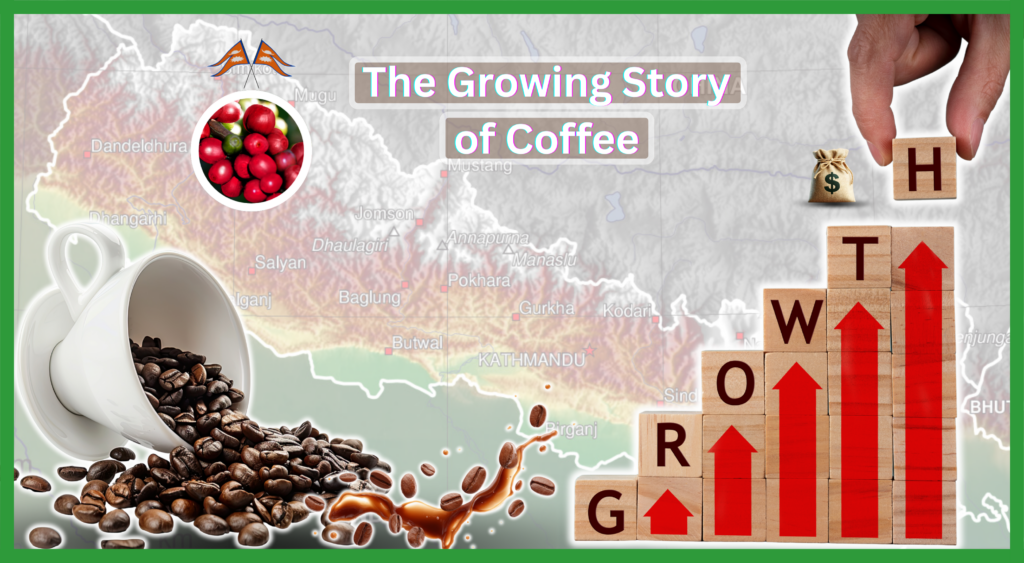
Nepal’s coffee sector has seen rapid growth in the number of farmers and areas under cultivation. Traditionally, coffee was limited to a few districts, but today it is cultivated in more than 40 districts across the hilly regions of the country according to Kathmandu Post.
Farmers in eastern regions like Ilam, Dhankuta, Kavrepalanchowk, and Bhojpur have embraced coffee farming, recognizing both its economic value and suitability to the hilly terrain according to Moald.gov.np.
Despite this growth, total annual production still remains relatively small compared to global leaders. Nepal currently produces roughly 500-600 metric tons of coffee per year as Kathmandu Post says.
Specialty and Organic Coffee Advantage
One reason Nepal’s coffee is gaining international interest is its quality. Much of the coffee is organically grown on small family farms in high altitudes. These beans often have unique flavour profiles that stand out in specialty coffee markets abroad, where consumers are willing to pay more for quality according to Reddit.
This creates a natural opportunity for Nepal to position itself not just as a volume producer, but as a specialty coffee origin, attracting premium buyers in Europe, the United States, Japan and South Korea.
Coffee Farming Challenges in Nepal
Though production is increasing, Nepal still faces several key challenges:
- Limited land under coffee cultivation compared to potential, estimates suggest Nepal could cultivate over 60,000 hectares of coffee, but much less is currently utilised according to Khabarhub.
- Farsightnepal says farmer support and infrastructure for improved yields, irrigation and quality processing are limited.
- According to Farsightnepal, certification and quality standard costs for international markets remain a hurdle for many small cooperatives.
2. Nepal Coffee Market Future – A Rapidly Growing Domestic Coffee Culture

Shifting Tastes in Nepal
Though Nepal has historically been a tea-loving nation, coffee consumption is growing fast, especially in urban areas like Kathmandu, Pokhara, and other cities. Young professionals and students frequent cafés, and coffee is increasingly becoming part of daily life according to Khabarhub.
There are now approximately 7,000 cafés nationwide, reflecting this shift toward coffee culture and lifestyle according to Nepali news portal Khabarhub.
Rising Domestic Demand and Imports
Even with expanding production, Nepal’s coffee output cannot meet its own domestic consumption. Local production of around 500-600 metric tons pales when compared to the thousands of tons demanded by coffee drinkers across the country each year according to Khabarhub.
As a result, Nepal increasingly imports coffee beans and finished coffee products. In recent years, coffee import value has risen sharply in some fiscal years reaching nearly Rs 500 million in imports according to Khabarhub.
This growth in imports is a clear indicator that domestic demand for coffee is growing faster than local production can supply.
Domestic Price Dynamics
Imported coffee often costs less than domestically produced beans, mainly due to economies of scale abroad, but Nepali coffee can fetch higher prices internationally due to its organic and specialty characteristics.
3. Nepal’s Coffee Export Scenario – Opportunities & Gaps
Export Growth and Market Reach
Nepal does export coffee, and its exports have grown modestly over recent years. But in terms of volume, exports remain small relative to both domestic demand and international market size.
For example, in a recent fiscal year, Nepal exported around 90-106 metric tons of coffee, while imports were several hundred tons according to Kathmandu Post.
This indicates that Nepal currently sells only a small fraction of its total production to global markets, a tiny percentage of the available demand worldwide according to Kathmandu Post.
International Markets and Premium Pricing
Nepalese coffee is known for its superior taste and organic quality, allowing it to sell at higher prices abroad in some markets reaching around USD 16 per kilogram for specialty coffee beans according to New Business Age.
According to Moald Primary export destinations include countries in Europe (like Germany and Switzerland), Japan, South Korea and North America, where demand for specialty and organically sourced coffee is strong.
Export Challenges and Untapped Potential
Despite the potential, several barriers slow Nepal’s export growth:
- According to Moald Small production volume limits the scale of exportable coffee.
- Quality certifications such as Organic, Fair Trade or Rainforest Alliance can be expensive and complex for small producers to obtain according to Farsightnepal.
- Logistics and quality control systems need strengthening to meet strict international standards according to Farsightnepal.
Addressing these issues will be essential for the Nepal coffee market future to scale globally, transforming Nepal from a small supplier to a recognized specialty coffee origin. Moreover, while demand for Nepali coffee abroad is strong, the current export output is a tiny portion, one estimate suggests Nepal taps only about 1-2% of its international demand potential according to Kathmandu Post.
4. The Global Coffee Market – Big and Growing

Massive Worldwide Demand
The global coffee market is huge and expanding. Recent industry reports estimate the total global coffee market value to be around USD 269 billion in 2024 and projected to reach USD 369 billion by 2030, growing at a compound annual growth rate (CAGR) of around 5% – 5.3% according to Grand View Research.
This growth is driven by rising coffee consumption in both traditional markets (Europe and North America) and fast-growing ones (Asia Pacific).
Specialty Coffee – A High-Growth Segment
The specialty coffee segment, which includes premium, single-origin, and ethically sourced beans is growing especially fast. A market research report estimated the specialty coffee market at over USD 100 billion in 2024, with expectations to grow to more than USD 180 billion by 2030 at a double-digit CAGR according to Grand View Research.
This trend shows consumers are seeking higher quality, unique taste experiences, and sustainability in all areas where Nepal can differentiate itself.
Global Production and Consumption Trends
According to Wikipedia, international coffee statistics, global coffee production in 2023 was over 11 million tonnes, with major producers including Brazil, Vietnam, Colombia, Indonesia and Ethiopia.
At the same time, consumption continues to grow steadily, with traditional markets pushing demand and emerging markets catching up. Some estimates project global coffee consumption will continue rising at about 2% annually over the coming decades according to Intracen.org.
Climate, Supply and Market Dynamics
Climate change and extreme weather have affected production in key countries like Brazil and Colombia, leading to occasional supply shortages and price volatility according to Reuters.
Higher global prices and supply constraints reshape how producers invest in irrigation, disease-resistant crops, and quality control. These trends underscore the need for resilience and innovation across the coffee value chain.
5. Why Coffee is a Strategic Opportunity for Nepal

Economic Benefits for Farmers
Coffee farming can be more profitable per hectare than many traditional crops, especially when beans are processed and sold at premium prices. Organic and specialty coffee can yield significantly higher returns, increasing farmer income and rural economic stability.
Moreover, coffee farming encourages value addition, processing and branding, which creates jobs beyond the farm gate in roasting, packaging, distribution and export marketing.
Export-Led Growth Potential
With the global specialty coffee market growing rapidly, Nepal can target segments that pay a premium for unique origins and flavors. A shift toward premium products, specialty blends and sustainable sourcing further reinforces opportunities for Nepal coffee market future, especially in Asia. Branding Nepali coffee as a distinct Himalayan specialty can attract niche buyers willing to pay competitive prices.
Expanding coffee exports will require:
- Enhanced production quality and volume
- Better access to certifications
- Stronger market linkages with overseas roasters
- Improved export logistics and packaging
Influence of Urban Coffee Culture
Urban consumption trends in Nepal also create growth opportunities. With more coffee shops and a culturally evolving coffee scene, domestic demand for both locally produced and imported coffee will keep growing.
This expanding market supports roasting and specialty brands, encouraging entrepreneurs to build coffee-related businesses.
6. Key Strategies to Grow Nepal’s Coffee Industry
For Nepal to fully capitalize on its coffee potential, the following strategies are essential:
1. Increase Land and Production Efficiency
Encourage more farmers to adopt coffee cultivation in suitable regions, invest in high-yield varieties, and provide training on best agronomic practices.
2. Strengthen Quality and Certifications
Help cooperatives and exporters secure international certifications, such as organic, Fair Trade, and specialty grades to access premium markets.
3. Improve Processing and Roasting Infrastructure
Setting up local processing units and roasting facilities can increase value addition and allow Nepal to export finished coffee products rather than just raw beans.
4. Build Market Linkages
Establish partnerships with international roasters and specialty coffee brands that can promote Nepali coffee on global platforms.
5. Supportive Government Policies
Policies tailored to coffee production, including financial incentives, research support, and export incentives would strengthen the sector’s long-term sustainability.
7. The Future Outlook – A Strong Espresso Shot Ahead
The Nepal coffee market future and the coffee farming in looks promising but requires focus, investment and strategic action:
- Domestic demand will continue rising as café culture grows according to Khabarhub analysis.
- Export markets offer premium opportunities for high-quality Nepalese coffee.
- Grand View Research says, Global trends in specialty coffee consumption and sustainable sourcing favour Nepali coffees has a unique profile.
- Economic growth through coffee can benefit rural farmers and the national economy.
Conclusion
Coffee farming in Nepal has a strong future. The country may produce less than global giants, but it has a big advantage in organic, high-altitude and specialty coffee. Local consumption is increasing, and international buyers are also showing more interest in Nepali beans. There is still a gap in production, certifications, and market access, but with proper training, better processing machines, quality packaging, branding and global partnerships. Nepal can grow its coffee sector and enter premium global markets. The Nepal coffee market future is bright for farmers and businesses that adopt smart strategies and value addition.