

“Smart poultry farming is not just about raising chickens – it’s about building a future-proof, profitable business.”
Smart Poultry Farm in Nepal has rise as one of the most profitable and sustainable agricultural businesses in recent years. With increasing demand for eggs, broiler meat, and processed poultry products, farmers have significant opportunities to grow their business. However, traditional poultry farming comes with challenges such as disease outbreaks, poor productivity and inefficient resource management.
This is where Smart Poultry Farming comes in. A smart farm uses technology, proper farm design, biosecurity, and data monitoring to optimize production and profitability. This guide is designed to help Nepali farmers and entrepreneurs start and operate a successful smart poultry farm in 2026, integrating practical solutions and expert insights from Planeteer Innovative.
Poultry Farming in Nepal: Overview & Data

According to FAO and Nepal Ministry of Agriculture reports:
- Nepal has over 7 million layer birds and 5 million broilers, producing more than 1.5 billion eggs annually.
- Around 5 million broiler birds, producing an estimated 50,000–60,000 tons of broiler meat annually
- The poultry sector contributes roughly 2-3% to Nepal’s GDP and provides employment to over 150,000 families, mostly in rural areas.
- Annual demand for poultry products is growing 10-12% per year, driven by urbanization, improved income and nutrition awareness.
Despite the growth, small-scale farms face challenges like:
- Disease outbreaks (Newcastle, Avian Influenza)
- Poor farm management and hygiene
- Limited access to modern feed and technology
- Market access and branding issues
Smart poultry farming addresses these challenges by integrating data-driven decisions, modern infrastructure and expert guidance.
What is a Smart Poultry Farm?
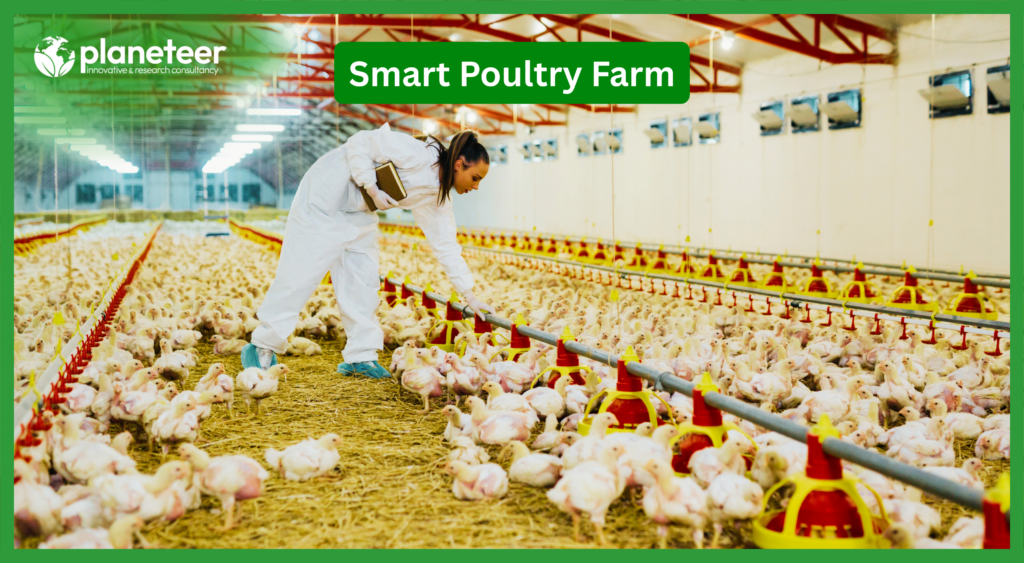
A Smart Poultry Farm is an advanced, technology-driven system designed to optimize poultry production while minimizing risks and manual labor. Unlike traditional farms, smart poultry farms integrate automation, monitoring, and data-driven management, making operations more efficient, profitable and sustainable.
Types of Smart Poultry Farms
- Fully Automated Poultry Farms:
- All feeding, drinking, and environment controls are automated.
- Best for large-scale commercial operations.
- Semi-Automated Poultry Farms:
- Combines manual labor with some automation (e.g., automated feeders or ventilation).
- Suitable for medium-scale farms or new entrepreneurs.
- IoT-Integrated Poultry Farms:
- Uses sensors and software to monitor temperature, humidity, feed, water and health.
- Enables remote management and data-driven decision making.
Benefits of Smart Poultry Farming
Investing in a smart farm offers multiple advantages:
Key Benefits:
- Increased egg and meat production per bird
- Reduced mortality rates through early disease detection
- Efficient feed and water management
- Easy monitoring of farm operations through sensors and software
- Compliance with FSMS (Food Safety Management System) standards
- Improved marketing potential with branded and quality-certified products
Step-by-Step Process to Start a Smart Poultry Farm in Nepal

Starting a Smart Poultry Farm in Nepal requires careful planning, proper setup, and continuous monitoring. Following a structured step-by-step approach ensures higher productivity, reduced disease risk, and sustainable profitability. Here’s a detailed process for Nepali farmers and entrepreneurs:
Step 1: Assess the Farm Location
The foundation of a successful Smart Poultry Farm in Nepal is choosing the right location. Consider:
- Ventilation & sunlight: Ensures birds remain healthy and reduces humidity.
- Access to clean water: Essential for drinking, cleaning and feed preparation.
- Drainage & hygiene: Prevents waterlogging and disease outbreaks.
- Distance from residential areas: Minimizes biosecurity risks.
Pro Tip: Planeteer Innovative provides location assessment and farm layout planning to maximize efficiency and safety.
Step 2: Choose the Right Poultry Breed
Selecting the correct breed is essential for productivity:
- Layers (egg production): Lohmann Brown, Hyline, Shaver
- Broilers (meat production): Cobb 500, Ross 308, Vencobb
- Dual-purpose / Native breeds: Suitable for combined egg and meat production
Pro Tip: A Smart Poultry Farm in Nepal tracks growth, feed, and egg production to optimize performance. Planeteer Innovative can guide breed selection based on climate, farm size and market demand.
Step 3: Design the Farm Housing
Housing is a critical factor for productivity:
- Space per bird: 1–1.5 sq.ft for broilers, 1.5–2 sq.ft for layers
- Climate control: Smart heating and cooling systems to maintain optimal temperature
- Ventilation: Fans or automatic vents
- Lighting: Controlled lighting cycles improve growth and egg-laying
Planeteer Innovative helps to custom farm layout, modular housing design, automated feeding and climate control recommendations.
Step 4: Implement Feed and Water Management
Nutrition is key to a productive Smart Poultry Farm in Nepal:
- Provide balanced feed rich in protein, vitamins and minerals
- Ensure clean, filtered water daily
- Use automatic feeders to maintain consistent supply
- Monitor feed and water consumption via smart sensors to reduce waste
Planeteer Innovative helps in Feed formulation consultancy and installation of automated feeders/waterers.
Step 5: Set Up Biosecurity and Health Monitoring
Diseases can cause severe losses. Smart poultry farms prevent them with:
- Footbaths, disinfectants, and PPE for farm staff
- Vaccination schedules for Newcastle, Gumboro, etc.
- Isolation zones for sick birds
- Automated health monitoring systems for early detection
Planeteer Innovative support in Lab testing, FSMS compliance support, and staff training in biosecurity.
Step 6: Integrate Technology and Data Management
Technology is what makes a poultry farm “smart”:
- IoT sensors monitor temperature, humidity, feed, water and health
- Data management tracks growth, feed efficiency, egg production and mortality
- Enables remote monitoring and decision-making
Planeteer Innovative helps implement IoT systems, software dashboards and automated alerts.
Step 7: Waste Management and Environmental Safety
Proper waste management ensures a safe and sustainable farm:
- Compost manure for organic fertilizer
- Treat wastewater before disposal
- Maintain ventilation to reduce ammonia
- Follow hygiene protocols for disease prevention
Planeteer Innovative support Eco-friendly waste management strategies and regulatory guidance.
Step 8: Marketing and Brand Building
Profitability depends on reaching the market effectively:
- Packaging: Hygienic, attractive, MAP or vacuum-packed eggs/meat
- Product diversification: Egg powder, frozen chicken, ready-to-cook items
- Distribution: Local, regional and export markets
- Branding: Use FSMS certification and quality assurance to build trust
Planeteer Innovative supports product development, packaging solutions, branding consultancy and market access.
Step 9: Training and Continuous Guidance
Training is critical for maintaining efficiency:
- Farm management and poultry handling
- Feed, health and biosecurity practices
- Lab testing and disease prevention
- Market and brand development strategies
Planeteer Innovative provides hands-on training and expert guidance throughout the farm cycle.
Step 10: Monitor and Scale Your Smart Poultry Farm
After setup, continuously monitor your farm to optimize:
- Feed efficiency
- Egg and meat production
- Mortality and disease patterns
- Financial performance
Expand gradually using modular housing, advanced automation, and data-driven decision making.
Common Challenges and Solutions
Challenges:
- Disease outbreaks → Solution: Vaccination + Lab Testing + Smart Biosecurity
- Feed inconsistency → Solution: Automated feeders + nutrient monitoring
- High mortality → Solution: Smart monitoring + regular health checks
- Market fluctuations → Solution: Value-added products + branding
Conclusion
Starting a Smart Poultry Farm in Nepal in 2026 offers tremendous opportunities for growth and profitability. By integrating modern farm design, automated systems, biosecurity, training, lab testing and marketing, farmers can significantly reduce risks and increase production.
With the right knowledge, proper planning, and expert guidance from Planeteer Innovative, anyone can transform a small farm into a highly productive, sustainable and profitable enterprise.